









I received this book for free from in exchange for an honest review. This does not affect my opinion of the book or the content of my review.
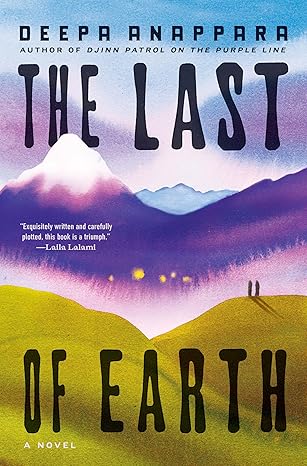
The Last of Earth by Deepa Anappara
Published by Random House on January 13, 2026
Genres: Historical, Historical Fiction
Pages: 352
1869. Tibet is closed to Europeans, an infuriating obstruction for the rapidly expanding British Empire. In response, Britain begins training Indians—permitted to cross borders that white men may not—to undertake illicit, dangerous surveying expeditions into Tibet.
Balram is one such surveyor-spy, an Indian schoolteacher who, for several years, has worked for the British, often alongside his dearest friend, Gyan. But Gyan went missing on his last expedition and is rumored to be imprisoned within Tibet. Desperate to rescue his friend, Balram agrees to guide an English captain on a foolhardy mission: After years of paying others to do the exploring, the captain, disguised as a monk, wants to personally chart a river that runs through southern Tibet. Their path will cross fatefully with that of another Westerner in disguise, fifty-year-old Katherine. Denied a fellowship in the all-male Royal Geographical Society in London, she intends to be the first European woman to reach Lhasa.
As Balram and Katherine make their way into Tibet, they will face storms and bandits, snow leopards and soldiers, fevers and frostbite. What’s more, they will have to battle their own doubts, ambitions, grief, and pasts in order to survive the treacherous landscape.
A polyphonic novel about the various ways humans try to leave a mark on the world—from the enduring nature of family and friendship to the egomania and obsessions of the colonial enterprise—The Last of Earth confirms Deepa Anappara as one of our greatest and most ambitious storytellers.

This novel takes its time, focusing more on reflection than on fast-paced action. The Last of Earth looks at ambition, loyalty, and power, but it does not treat exploration as something heroic. Instead, it shows how curiosity and mapmaking can be used as tools of entitlement in an empire.
The book’s strongest point is its moral tension. Balram acts out of friendship and survival, not honor, and Katherine’s ambition makes sense but is never fully justified. Anappara gives both characters depth without asking readers to forgive their actions. The writing is careful and creates a strong mood. Sometimes the pace feels slow, but this restraint makes the emotions hit harder.
This story does not rely on spectacle or nonstop action. Instead, it takes its time, asking who is remembered, who is taken advantage of, and who pays the price for being discovered.